This guide delves into how many amps does a gaming PC use offering vital insights for gamers balancing passion with practicalities Understanding your systems power consumption is key to optimizing performance preventing overloads and managing electricity bills We cover everything from average amp draw for different PC builds to specific component usage like GPUs and CPUs Discover how to calculate your rigs amperage needs choose the right power supply and ensure your setup is safe and efficient for uninterrupted gaming sessions Learn practical tips for power management and making smart upgrade decisions without breaking the bank This informational resource is tailored for the average gamer aged around 36 who seeks clarity and value keeping up with trends without unnecessary hype Get ready to level up your understanding of PC power usage
Related games- Guide to Insane Roblox Games for Pro Gamers
- How to Fix Classic Axis 16 GTA Vice City PC Guide
- How Gangs Shaped GTA San Andreas Gameplay
- How To Style The Best Roblox Headbands In 2026
- Guide to Biy Hair Roblox: Style Your Avatar Now
What Factors Determine How Many Amps a Gaming PC Uses?
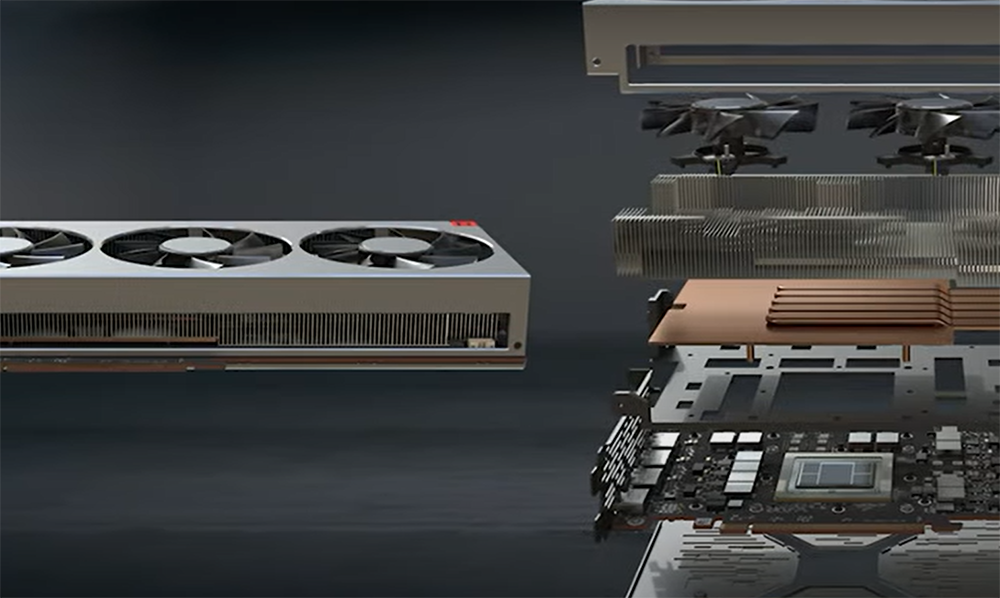
The total amperage a gaming PC uses is primarily determined by its components and their power draw, especially under load. The Graphics Processing Unit (GPU) is almost always the hungriest component, followed by the Central Processing Unit (CPU). Other elements like the motherboard, RAM, storage drives (SSDs/HDDs), fans, and peripherals also contribute. Modern high-end GPUs can draw hundreds of watts, translating directly into higher amperage. Specific games and their graphical intensity, system overclocking, and Power Supply Unit (PSU) efficiency also play significant roles in the overall amp draw from your electrical outlet.
How Do I Calculate the Amps My Gaming PC Needs?
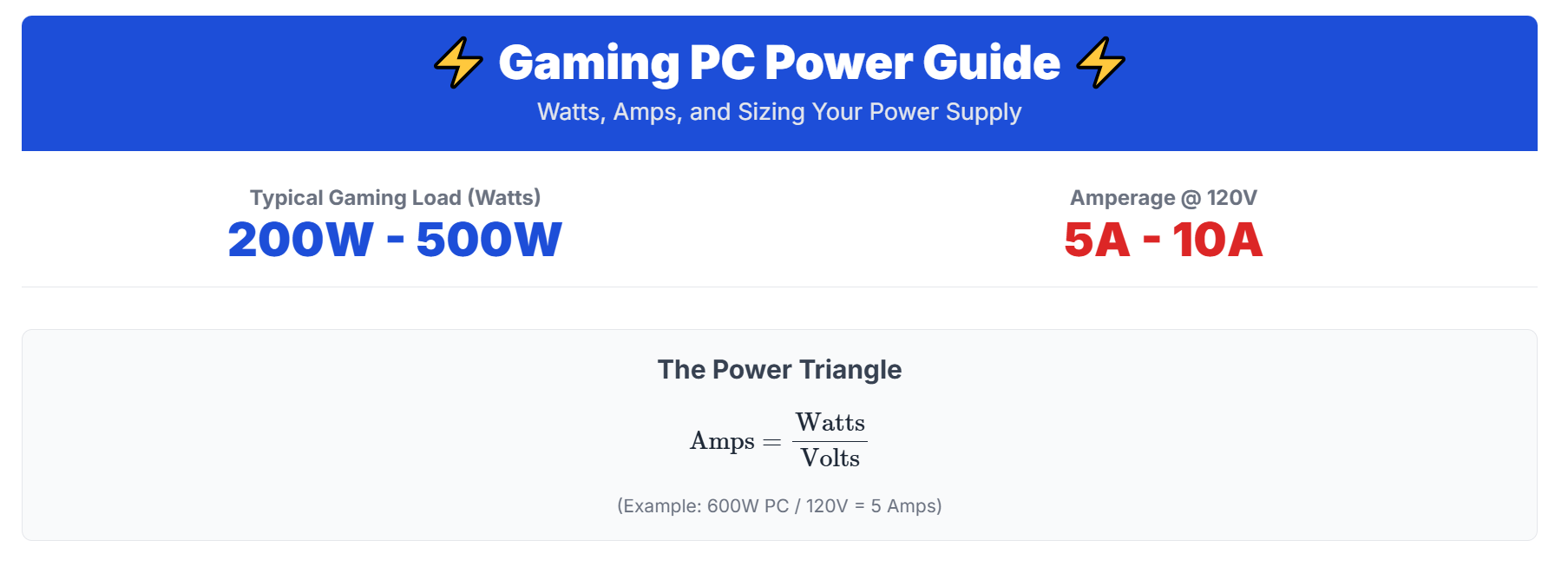
To calculate the amperage your gaming PC needs, first determine its total wattage. You can sum the TDP of major components or use online PSU calculators for an accurate estimate. Once you have the total wattage, use the formula Amps = Watts / Volts. In the US, household outlets are typically 120 volts. For example, a 600W PC draws 5 amps (600W / 120V). Always calculate based on peak gaming load and add a 20-30% buffer to ensure your circuit, typically 15 or 20 amps, isn't overloaded.
What is the Average Amp Draw for Different Gaming PC Tiers?
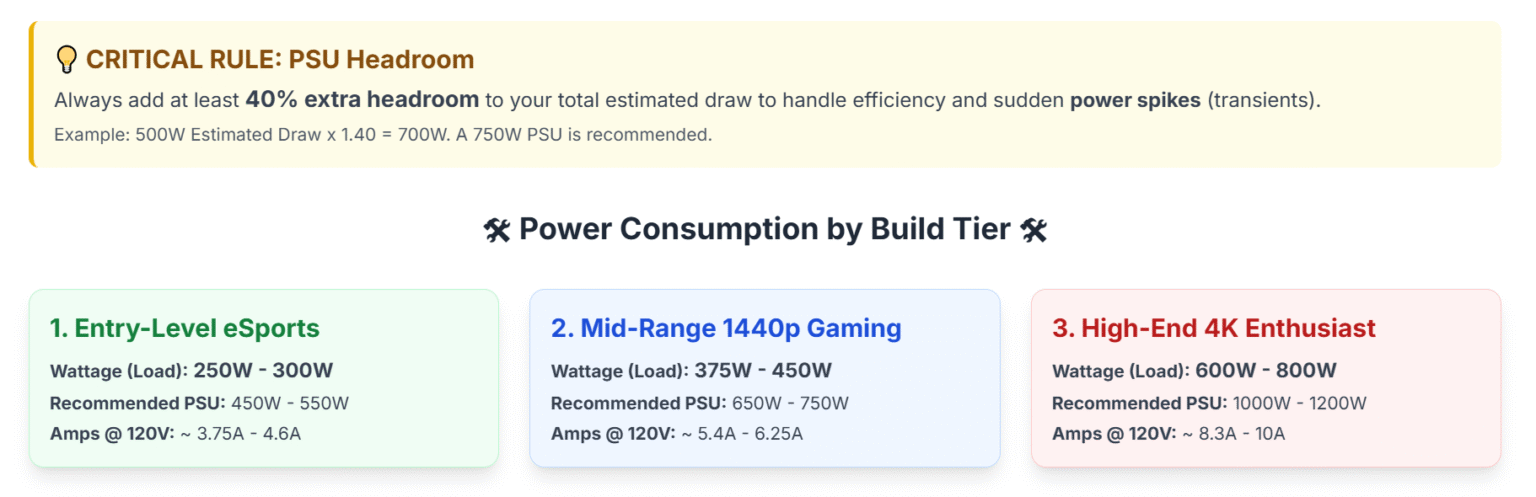
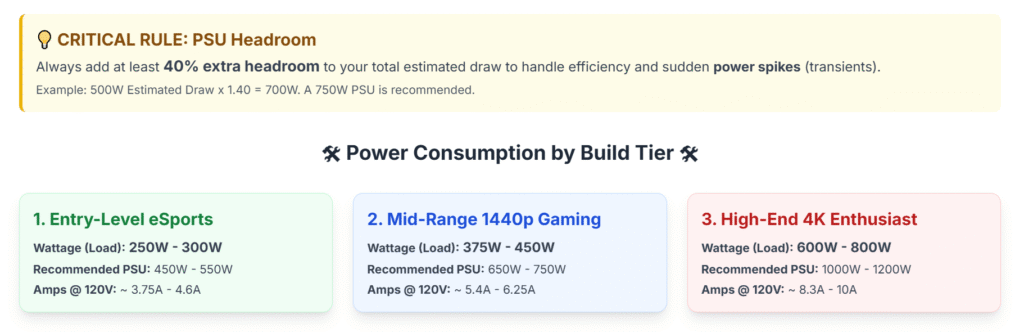
The average amp draw for a gaming PC varies by tier. An entry-level PC (200-350W) draws 1.7-2.9 amps, a mid-range PC (350-550W) draws 2.9-4.6 amps, a high-end PC (550-750W) draws 4.6-6.3 amps, and an enthusiast PC (750-1000+W) can draw 6.3-8.3+ amps, all at peak gaming load and assuming a 120V US outlet. Idle usage is much lower. Specific component choices significantly influence these figures, so a tailored calculation is always recommended for your exact build.
Which Gaming PC Components Use the Most Amps?
The Graphics Processing Unit (GPU) is by far the most power-hungry component in a gaming PC, drawing the most amps. High-end GPUs can consume 300-450+ watts under full load. The Central Processing Unit (CPU) is the second largest consumer, with powerful models using 100-250 watts. Other components like motherboards, RAM, SSDs, and fans contribute only a few watts each. Understanding these primary power draws helps in selecting an adequate power supply and optimizing your system's overall electrical footprint.
How Does PSU Efficiency Affect My Gaming PC's Amp Draw?
PSU efficiency, indicated by 80 PLUS ratings (Bronze, Gold, Platinum), dictates how much AC power from the wall is converted into usable DC power for your PC versus how much is lost as heat. A higher efficiency PSU (e.g., 80 PLUS Gold at 87%) draws less total power from the wall outlet to deliver the same required power to your components. This means an efficient PSU slightly lowers the overall amperage drawn from your electrical circuit, leading to minor energy savings and less heat generation, contributing to a more efficient gaming setup.
Can My Home's Electrical Circuit Handle My Gaming PC?
Most US household circuits are 15 or 20 amps at 120 volts, safely handling about 1440W or 1920W respectively (using the 80% continuous load rule). To determine if your circuit can cope, sum the wattage of all devices plugged into it, including your PC, monitor, and peripherals. A high-end gaming PC drawing 800W is usually fine on a 15-amp circuit if it's the main load. Overloading occurs when total draw exceeds the circuit's capacity, leading to tripped breakers and potential hazards. A dedicated circuit is ideal for powerful setups.
What Are the Risks of Insufficient Amperage for a Gaming PC?
Insufficient amperage for a gaming PC primarily risks tripping your circuit breaker, which abruptly cuts power to prevent electrical hazards like overheating wires and fires. This sudden power loss can corrupt data and potentially damage hardware. Internally, inadequate power delivery can cause system instability, random crashes, reboots during intense gaming, and performance throttling. Ensuring your circuit can handle how many amps your gaming PC uses is crucial for maintaining system stability, prolonging component life, and guaranteeing electrical safety for your entire setup.
Hey fellow gamers! We all know the thrill of diving into a new world, teaming up with friends, or chasing that elusive win. For many of us, gaming is that perfect escape after a long day of work, managing family life, or simply staying on top of our responsibilities. We want our rigs to perform flawlessly, giving us the best experience without any hiccups. But let's be real, sometimes the technical stuff can feel like a boss battle itself. One question that often pops up, especially when planning upgrades or trying to understand those utility bills, is "how many amps does gaming PC use?" It's a critical question that impacts not just your wallet but also the safety and stability of your entire setup.
You're not alone if you've wondered about this. With 87% of US gamers playing regularly, often clocking in 10+ hours a week, and with the rise of power-hungry components, understanding your system's electrical draw is more important than ever. Whether you're optimizing for frame rates, looking to upgrade your GPU without tripping a breaker, or just trying to be more mindful of energy consumption, getting a grip on amperage is essential. This guide is designed to cut through the jargon, giving you practical, actionable insights into how many amps your gaming PC uses, what influences it, and how to manage it like a pro. Let's make sure your gaming sessions are smooth, safe, and stress-free.
What Factors Determine How Many Amps a Gaming PC Uses?
The total amperage a gaming PC uses is primarily determined by its components and their power draw, especially under load. The Graphics Processing Unit (GPU) is almost always the hungriest component, followed by the Central Processing Unit (CPU). Other elements like the motherboard, RAM, storage drives (SSDs/HDDs), fans, and peripherals (keyboard, mouse, monitor) also contribute, albeit to a lesser extent. Modern high-end GPUs, for instance, can draw hundreds of watts, which translates directly into higher amperage. The specific games you play and their graphical intensity also play a huge role; a demanding AAA title will push your GPU and CPU harder than an indie game or web browsing, leading to increased power consumption.
Additionally, system overclocking significantly boosts power draw as components require more voltage to maintain higher frequencies. Power Supply Unit (PSU) efficiency is another factor; while a more efficient PSU doesn't change what components *draw*, it means less power is wasted as heat, making the system more efficient overall in converting wall power. Ambient temperature can also subtly affect power draw, as components might work harder to stay cool in warmer environments. Understanding these variables is the first step to accurately estimating how many amps does gaming PC use in your unique setup.
How Do I Calculate the Amps My Gaming PC Needs?
Calculating the amperage your gaming PC needs involves a few straightforward steps. First, you need to determine the total wattage your PC consumes. You can estimate this by summing the TDP (Thermal Design Power) or typical power draw of your major components, especially the GPU and CPU. Online PSU calculators are excellent tools for a more accurate estimate, as they account for various components and provide a recommended PSU wattage. Once you have the total wattage, you can convert it to amps using Ohm's Law formula: Amps = Watts / Volts.
In the US, standard household outlets typically deliver 120 volts. So, if your gaming PC draws 600 watts, the calculation would be 600W / 120V = 5 amps. It's crucial to remember this is the draw from the wall outlet. Your PSU converts this power into various DC voltages for internal components. Always consider the maximum possible load (gaming at peak performance) when calculating to ensure your circuit can handle it. Adding a buffer of 20-30% to your calculated amperage is a smart safety measure, ensuring you don't push your circuit too close to its limit, which is typically 15 or 20 amps for most household circuits.
What is the Average Amp Draw for Different Gaming PC Tiers?
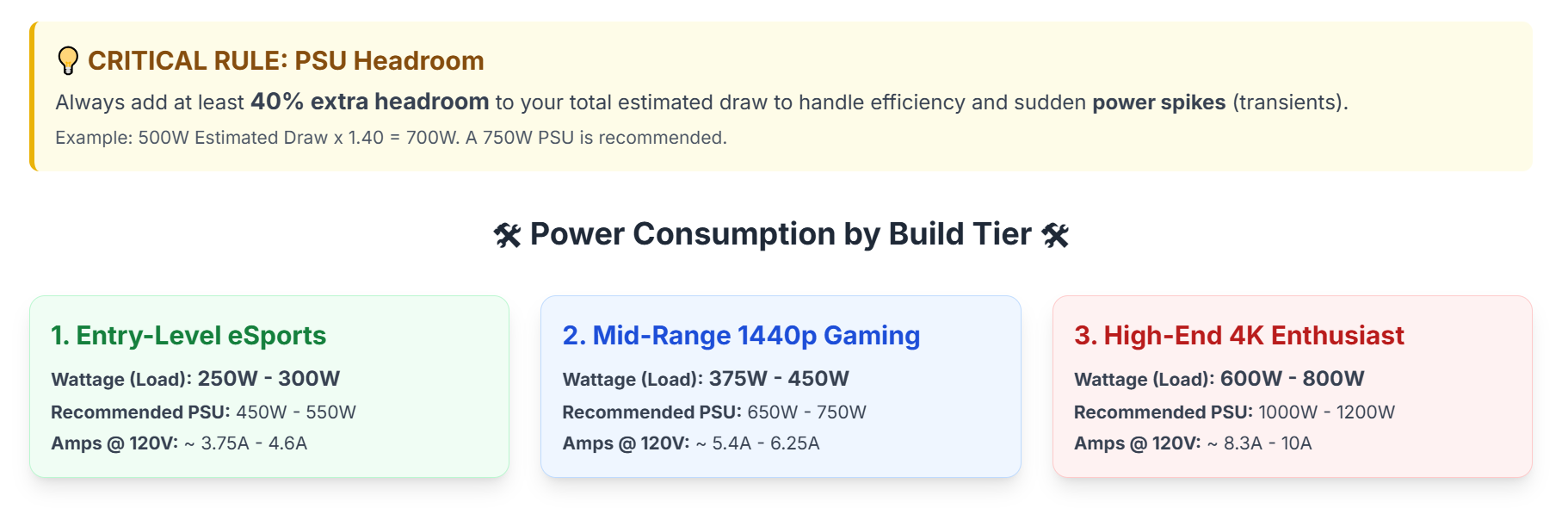
The average amp draw for gaming PCs varies significantly based on their component tier. Here's a general breakdown, assuming a 120V outlet in the US:
- Entry-Level Gaming PC: (e.g., GTX 1660 Super, Ryzen 5 3600) typically consumes 200-350 watts.
- Mid-Range Gaming PC: (e.g., RTX 3060/4060, Ryzen 5 7600/Intel i5-13600K) might draw 350-550 watts.
- High-End Gaming PC: (e.g., RTX 4070/4070 Ti, Ryzen 7 7800X3D/Intel i7-14700K) often uses 550-750 watts.
- Enthusiast/Extreme Gaming PC: (e.g., RTX 4080/4090, Ryzen 9 7950X3D/Intel i9-14900K) can easily reach 750-1000+ watts.
Converting these wattages to amps: an entry-level PC might draw 1.7 to 2.9 amps, a mid-range PC 2.9 to 4.6 amps, a high-end PC 4.6 to 6.3 amps, and an enthusiast PC 6.3 to 8.3+ amps. These figures represent peak gaming load. Idle or light usage (like browsing Discord or watching streams) will result in much lower amp draws, often under 1 amp for most systems. It's always best to check specific component reviews or use a dedicated PSU calculator for your exact build.
Which Gaming PC Components Use the Most Amps?
Without a doubt, the Graphics Processing Unit (GPU) is the most power-hungry component in almost any modern gaming PC, and therefore the biggest contributor to how many amps does gaming PC use. High-end GPUs like the NVIDIA RTX 4090 or AMD Radeon RX 7900 XTX can draw upwards of 300-450 watts on their own under full load, sometimes even more during power spikes. The Central Processing Unit (CPU) comes in second, with high-performance Intel i9 or AMD Ryzen 9 processors consuming between 100-250 watts, depending on the model and task.
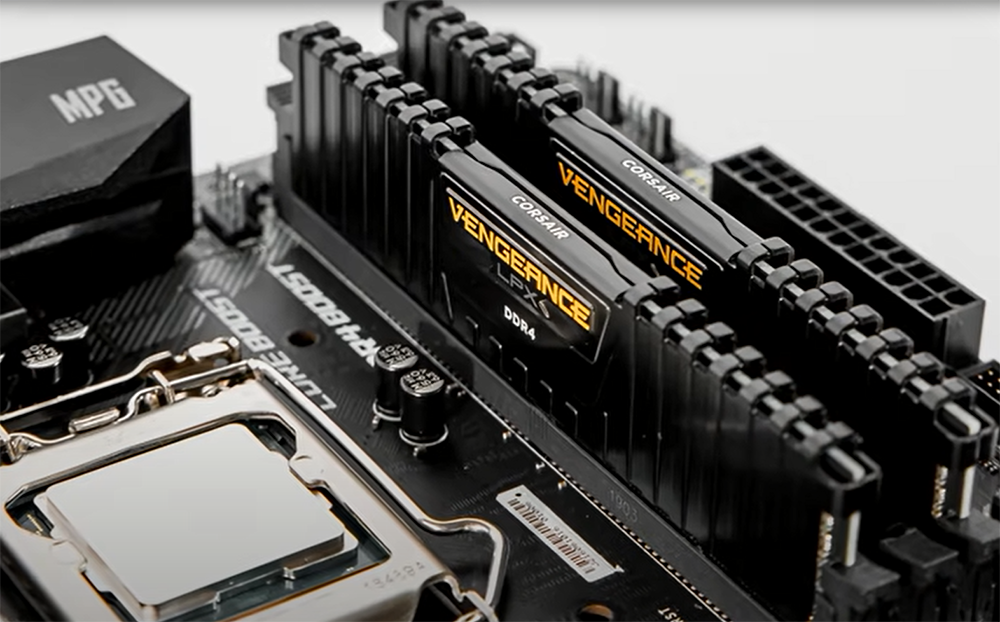
Beyond these two giants, other components have significantly lower power requirements. Motherboards, RAM, and solid-state drives (SSDs) typically consume only a few watts each. Case fans and CPU coolers also draw minimal power. However, when combined, these smaller components can add up, making a well-rounded PSU calculation crucial. For gamers balancing budgets and performance, knowing where your power goes helps prioritize upgrades. For instance, an older system with a new, powerful GPU will likely need a PSU upgrade to handle the increased amp draw effectively and prevent system instability or overloads.
How Does PSU Efficiency Affect My Gaming PC's Amp Draw?
PSU efficiency ratings, like 80 PLUS Bronze, Gold, Platinum, or Titanium, indicate how effectively the power supply converts AC power from your wall outlet into usable DC power for your PC components. An 80 PLUS Gold certified PSU, for example, is at least 87% efficient at 50% load. This means that if your PC components *require* 500 watts of DC power, a Gold PSU will draw approximately 575 watts (500W / 0.87) from the wall. The remaining 75 watts are lost as heat during the conversion process.
Therefore, a higher efficiency PSU draws *less* total power from the wall outlet to deliver the same amount of power to your components. While the internal components still demand the same watts, a more efficient PSU reduces the "waste" wattage, which in turn slightly lowers the total amperage drawn from your electrical circuit. This can lead to marginal savings on your electricity bill over time and produces less heat inside your PC case, potentially extending component lifespan. It's a small but significant factor when considering how many amps does gaming PC use and optimizing your system's overall energy footprint.
Can My Home's Electrical Circuit Handle My Gaming PC?
Ensuring your home's electrical circuit can handle your gaming PC's amp draw is vital for safety and stability. Most standard household circuits in the US are rated for either 15 amps or 20 amps at 120 volts. A 15-amp circuit can safely handle about 1440 watts (15A * 120V * 0.80 for continuous load), and a 20-amp circuit can handle around 1920 watts (20A * 120V * 0.80). The 80% rule is a safety guideline for continuous loads to prevent circuit breakers from tripping frequently or overheating.
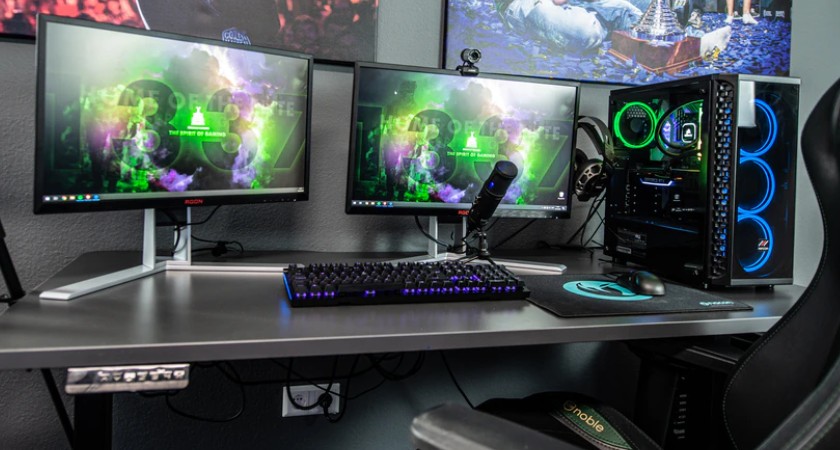
To check if your circuit can cope, add up the total wattage of all devices plugged into that specific circuit, including your PC, monitor, speakers, desk lamps, and any other electronics. If your high-end gaming PC draws 800 watts, and your monitor draws 50 watts, you're at 850 watts. This is well within a 15-amp circuit's capacity, especially if it's the only major device. However, if you also have a mini-fridge, a printer, and a powerful space heater on the same circuit, you could quickly approach or exceed the limit, leading to tripped breakers during intense gaming sessions. A dedicated circuit for your gaming setup is ideal if you have a very powerful rig and many peripherals.
What Are the Risks of Insufficient Amperage for a Gaming PC?
Running a gaming PC on a circuit with insufficient amperage poses several risks, ranging from minor annoyances to serious safety concerns. The most common immediate issue is a tripped circuit breaker. This happens when your PC (and other devices on the same circuit) tries to draw more current (amps) than the circuit is designed to handle, causing the breaker to cut power to prevent overheating and potential fires. This abrupt power loss can corrupt game saves, damage operating system files, and even shorten the lifespan of your hardware due to sudden shutdowns.
Beyond trips, chronic overloading of a circuit can lead to electrical hazards like overheating wires, which could potentially cause fires. Even if your breaker doesn't trip, running close to the limit can stress your electrical system. For your PC itself, insufficient power delivery can manifest as system instability, random crashes, reboots during graphically intense moments, or performance throttling as components don't receive enough power to operate at their intended speeds. Understanding how many amps does gaming PC use is crucial to avoid these frustrating and potentially dangerous situations, ensuring your components run reliably for years to come.
How Can I Reduce My Gaming PC's Power Consumption (and Amps)?
Reducing your gaming PC's power consumption, and consequently its amp draw, is a smart move for your wallet and the environment. Here are some practical tips:
- Enable Power Saving Modes: Use Windows or macOS power plans. Set your display to turn off after inactivity and put your PC to sleep when not in use.
- Undervolt Your GPU/CPU: This advanced technique involves reducing the voltage supplied to your components while maintaining similar performance. It requires careful tuning but can significantly lower power draw and heat.
- Cap Frame Rates: If your monitor is 60Hz, rendering 200 FPS in a game is overkill. Capping your frame rate to match your monitor's refresh rate (or slightly above) reduces GPU workload and power use without sacrificing perceived smoothness.
- Lower Graphics Settings: While gamers love ultra settings, sometimes dialing back a few non-essential options (like shadow quality or anti-aliasing) can save significant power with minimal visual impact.
- Use an Efficient PSU: As discussed, an 80 PLUS Gold or Platinum PSU will waste less power during conversion, lowering your total wall draw.
- Disconnect Unused Peripherals: USB devices, external drives, and even phone chargers draw a trickle of power. Unplug them when not needed.
- Monitor Background Apps: Close unnecessary programs running in the background, especially during gaming, as they can consume CPU resources.
When Should I Upgrade My Power Supply Unit (PSU) for Amperage?
Upgrading your Power Supply Unit (PSU) becomes necessary when your current unit can no longer meet the power demands of your components, especially if you're asking how many amps does gaming PC use after an upgrade. The most common trigger for a PSU upgrade is installing a new, more powerful GPU. Modern graphics cards are increasingly power-hungry, and a significant jump in GPU performance almost always means a significant jump in wattage requirements, which directly translates to higher amp draw.
You should also consider a PSU upgrade if you plan to overclock your CPU or GPU, as this increases their power needs beyond stock specifications. Signs that your current PSU is struggling include random system crashes during intense gaming, unexplained reboots, or components underperforming despite adequate cooling. Before purchasing a new component, particularly a GPU, always use an online PSU calculator to determine the recommended wattage for your *entire* system, including the new part. This ensures you buy a PSU with enough headroom (typically 20-30% above estimated peak usage) to handle transient power spikes and provide stable power, preventing potential system instability and component damage, and safely managing how many amps does gaming PC use.
Navigating the ins and outs of how many amps does gaming PC use might seem daunting, but armed with this knowledge, you're well-equipped to manage your setup like a seasoned pro. We've covered everything from identifying power-hungry components like your GPU and CPU to calculating your system's amp draw and ensuring your home circuits can handle the load. Remember, understanding amperage isn't just about avoiding tripped breakers or saving a few bucks on your electricity bill; it's about ensuring a stable, safe, and optimal gaming experience for those precious hours you dedicate to your favorite virtual worlds. With US gamers regularly dedicating significant time to their passion, optimizing your setup means more fun and less frustration.
By applying these practical tips—from calculating wattage to considering PSU efficiency and even simple power-saving habits—you can confidently build, maintain, and upgrade your gaming rig. You'll enjoy seamless performance, better peace of mind, and perhaps even some extra cash for those in-game purchases or a new title. What's your biggest gaming challenge when it comes to managing your gaming PC's power? Comment below and let's keep the conversation going!
Does a gaming monitor add significantly to amp usage?
While essential, gaming monitors typically do not add a significant amount to your PC's amp usage compared to the core components. A modern 27-inch 144Hz monitor might draw 30-60 watts, translating to about 0.25-0.5 amps at 120V. While it's part of your total circuit load, the GPU and CPU remain the primary power consumers. High-refresh-rate and larger monitors generally use more power than standard ones.
Is undervolting a safe way to lower PC amps?
Yes, undervolting your GPU or CPU can be a very safe and effective way to lower your PC's power consumption and thus reduce its amp draw, provided it's done carefully. It involves reducing the voltage supplied to a component without significantly impacting its performance. It can lead to lower temperatures, less noise, and energy savings. However, it requires careful testing and stability checks to prevent crashes or instability. Many gamers successfully undervolt their systems for better efficiency.
What's the difference between amps and watts for a gaming PC?
Watts (W) measure the total power consumed by your gaming PC, while Amps (A) measure the electrical current flowing through the circuit. They are related by the formula Watts = Amps x Volts. So, if your PC uses 600 watts and your outlet is 120 volts, it draws 5 amps. Watts tell you how much work is being done, while amps tell you the intensity of the electrical flow, crucial for circuit breaker ratings.
How often should I check my gaming PC's power draw?
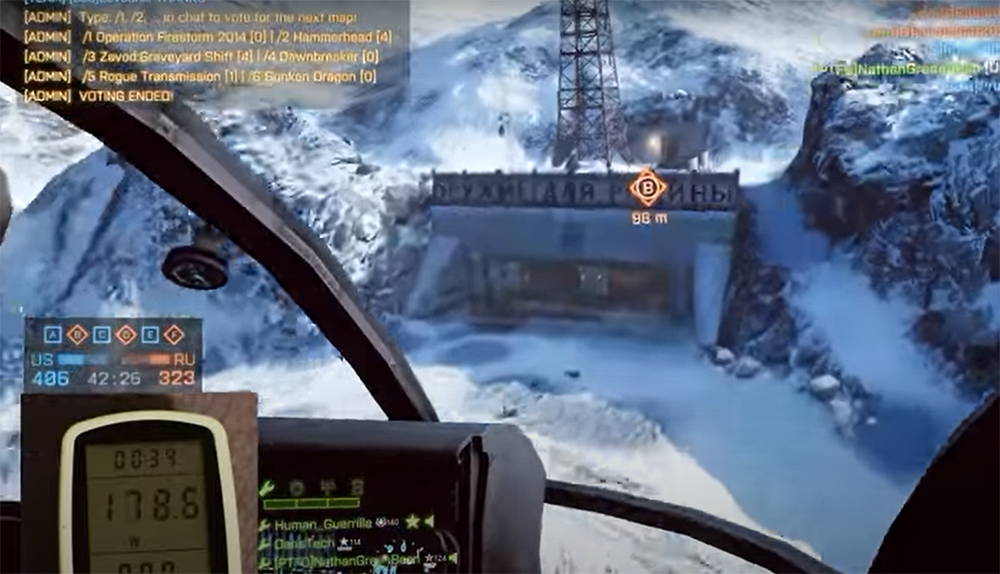
You should primarily check your gaming PC's power draw when you make significant hardware changes, especially upgrading your GPU or CPU. A quick check with an online PSU calculator or a Kill-A-Watt meter is also wise if you experience unexplained system instability or frequently trip a circuit breaker. Otherwise, for stable setups, routine checks aren't typically necessary unless you're focused on energy optimization.
Are smart power strips useful for gaming setups?
Smart power strips can be very useful for gaming setups, especially for managing "vampire" power draw from peripherals. They allow you to easily cut power to monitors, speakers, external drives, and chargers when your PC is turned off or in sleep mode, preventing them from drawing a constant trickle of electricity. Some advanced strips can even detect when your PC (the master device) turns off and automatically power down other connected devices, contributing to energy savings.
Does leaving my PC on idle use many amps?
No, leaving your gaming PC on idle generally does not use many amps. Modern CPUs and GPUs are designed with aggressive power-saving features that drastically reduce their power consumption when not under load. An idle gaming PC, even a high-end one, might only draw 50-100 watts (0.4-0.8 amps at 120V), which is significantly less than during active gaming. Enabling proper power management settings can further reduce this idle draw.
Average amp draw varies significantly by PC components. GPUs are often the biggest power consumers. Understanding amps helps prevent circuit overloads. Calculate total wattage then convert to amps for your region. Proper PSU selection is crucial for stability and efficiency. Power management tips can save electricity costs. Upgrading components impacts amp usage.
35



How Many Watts Is A Gaming PC Really Using How Many Amps Does A Gaming PC Use . How Many Amps Does A Computer Use Laptop Desktop Gaming PC Guide How Many Amps Does A Computer Use . How Many Amps Does A Gaming PC Really Use Find Out YouTube . How Many Amps Does A Gaming PC Use GamingProfy How Many Amps Does A Gaming Pc Use . How Many Amps Does A Gaming PC Use JOCA The Amps For Your Gaming PC


How Many Amps Watts Does A Gaming PC Use How Much Electricity Does A Ella Don 0oqMvhc1ntw Unsplash 1024x683 . How Many Amps Watts Does A Gaming PC Use How Much Electricity Does A Image . How Many Watts Is A Gaming PC Really Using Power Consumption Comparison Analysis . The Gaming PC You Need To Build For 2026. How Many Watts Does A Gaming PC Use A General Overview Evaluating Various



How Many Amps Does A Gaming PC Use GamingProfy How Many Amps Does A Gaming Pc Use 1 . How Many Amps Does A Gaming PC Use JOCA Amps And Power Consumption . How Many Watts Does A Gaming PC Use Complete Guide How Many Watts Does A Gaming PC Use . How Many AMPS Does A Gaming PC Use AMPS Does A Gaming PC Use . How Many Amps Does A Gaming PC Use Gaming For PC How Many Amps Does A Gaming Pc Use
How Many Amps Watts Does A Gaming PC Use How Much Electricity Does A Image 1 . How Many Amps Watts Does A Gaming PC Use How Much Electricity Does A Image 1 1536x497 . How Many Amps Does A Gaming PC Use Accurate Explanation PC Power Consumption . How Many Watts Is A Gaming PC Really Using How Many Watts Does A Gaming PC Use . How Many Amps Watts Does A Gaming PC Use How Much Electricity Does A Image 1 300x97




How Many Amps Watts Does A Gaming PC Use How Much Electricity Does A Image 1 1024x332 . How Many Amps Does A Computer Use Laptop Desktop How Many Amps Does A Computer Use . How Many Amps Does A Gaming PC Use JOCA 3Average Amps For Entry Level Gaming PCs . How Many Amps Does A Gaming PC Use JOCA 5Common Questions About Amps And Gaming PCs . How Many Amps Does A Computer Use Laptop Desktop Gaming PC Guide D7626254 B3b3 4bf2 94c6 CR0 0 3000 600 SX1920



How Many Amps Does A Gaming PC Use JOCA Power Cable 768x768 . How Many Amps Does A Gaming PC Use JOCA OVERHEAD BARE CONDUCTOR . How Many Amps Does A Gaming PC Use JOCA Aerial Bundled Cable 1024x1024 . How Many Amps Does A Gaming PC Use JOCA Rubber Cable . How Many Amps Does A Gaming PC Use GamingProfy How Many Amps Does A Gaming Pc Use 4

How Many Amps Does A Gaming PC Use JOCA 4Optimizing Your Gaming PCs Amp Usage.webp. How Many Amps Does A Gaming PC Use JOCA Company News . How Many Amps Does A Gaming PC Use GamingProfy How Many Amps Does A Gaming Pc Use 3 . How Many Amps Does A Gaming Computer Use . How Many Amps Does A Gaming PC Use GamingProfy How Many Amps Does A Gaming Pc Use 2